Showing posts with label breast lift. Show all posts

Tuesday, April 26, 2011

Decisions in breast lift surgery. Incisions, scars, and breast shape.


A frequent discussion that takes place with regards to breast shaping and breast lift surgery is scars. It is no surprise that the desire to minimize and prevent scars on the breast is an important discussion point. The breasts, aside from breast feeding, are an extremely sensual part of the female body. For women who have lost their natural breast shape and have developed laxity and drooping a breast shaping procedure such as a breast lift is usually required to restore the position of the breast tissue, shape and size of the areola, and firmness or skin tension to its natural and most aesthetic level.
My discussion, whenever skin is in excess or there is excess skin and soft tissue laxity, inevitably revolves around the idea that fat and mucsle can be changed through diet and excercise but significant excess skin must be removed surgically. Removal of excess skin by definition involves making an incision. For breast lift surgery, an incision is needed to make the areola smaller, to elevate the areola to a higher position, and to remove the excess skin and contour the breast and breast tissue.
The inevitable questions then becomes, do we accept the needed incisions and subsequent scars in exchange for better breast shape? The simple answer is that the overall shape is always more important than an extra incision. The more detailed discussion goes as follows. An incision that heals well and is in the end a paper thin scar should be accepted in exchange for a significantly improved shape. I have never had one patient that has regretted getting a breast lift. They see the improved breast shape and position and the presence of paper thin scars becomes a very easy tradeoff to make. Remember, we make incisions on the face for facial rejuvenation including incisions on the eyelids and nose for eyelid and nose shaping. It seems that a well healed and positioned incision that delivers the best result possible in terms of breast shape and position should be judged in the same way.
When it comes to incisions and scars two things must be understood. If they are done properly the final scar should be paperthin and nearly invisible when full healing has occured. The second is that a perfectly shaped breast with a thin, nearly invisble incision is much more aesthetic and desireable then a droopy breast with a large areola and no scars. In the end, its the patient who has to decide what they value most. For my family, friends, and loved ones I would certainly steer them toward better shape.

All the best,
Board Certified Plastic Surgeon
Phoenix/Scottsdale AZ

Friday, September 12, 2008

Bra Line Back Lift


What is the Bra Line Back Lift?
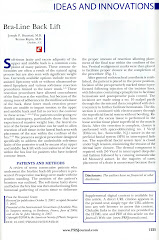
The Bra Line Back Lift is a new procedure that helps correct the soft-tissue rolls and folds of the middle and upper back. There are a large number of women who complain about the presence of these soft-tissue folds. Many express the desire to wear form fitting clothes in the current fashions but hesitate to do so because of the appearance that these back rolls present. Until now, there was relatively little that could be offered to help these patients.The Bra Line Back Lift was co-authored by me and Dr. Hunstad. Scheduled to be published in the October 2008 issue of Plastic and Reconstructive Surgery Journal, the leading journal for the American Society of Plastic Surgery (ASPS), the Bra Line Back Lift procedure was designed to improve the appearance of the upper and middle back by correcting the presence of soft-tissue folds and rolls and allowing a smooth, even-flowing silhouette to be achieved. In recent weeks, there has been increasing media coverage of the procedure. Below are the details of the procedure including ideal candidates, recovery time, and additional information.
Who are candidates for the Bra Line Back lift?
There is actually a wide range of patients that could be good candidates for the Bra Line Back Lift procedure. We have noticed that the most frequent request is from patients that are in their 40’s or 50’s, are in relatively good shape, but because of either aging, excess sun exposure, or secondary to weight fluctuation, they have excess soft-tissue laxity in the upper and middle back that present as rolls and folds. It is important to note that skin and soft-tissue laxity cannot be exercised and therefore cannot be tightened. Liposuction alone has been used to treat these areas but this just improves the presence of fat and it does not correct the laxity of the skin and soft-tissue which is the main problem.
How long does it take and what is the recovery time?
The procedure takes about one hour. It is performed under general anesthesia and as an outpatient procedure. The recovery process is fairly easy as reported by many patients. There is often not a lot of discomfort and beside the restriction of heavy lifting and vigorous activity, the patients are usually allowed to increase their activity level as tolerated. Drains are usually not used and since all of the sutures are internal and dissolved by the body, there is no cumbersome dressing needed and patients are allowed to shower in 24-48 hours.
Are there any scars?
Yes. Scars are always created whenever surgery is performed। The Bra Line Back Lift has the benefit of placing the scar within the borders of the bra strap. In discussing the Bra Line Back lift procedure, I tell my patients that a visible scar will be present, that it will be hidden by the horizontal part of the bra strap, and that in the end, they are choosing between the presence of back rolls or a scar. The benefit of choosing to undergo the Bra Line Back Lift is that with all form fitting clothes, the folds are now gone and a smooth silhouette is present. With the exception of a backless dress or the very tiniest bikini top, the Bra Line Back Lift scar is usually well hidden.

Feel free to ask any questions that I might not have covered. Before and after photos can be seen in our office as well as in The Atlas of Abdominoplasty textbook.

All the best,
Dr. Remus Repta